How to watch the Leonids for free from the UAE this week
The Leonid meteor shower peaks around 4am UAE time on Wednesday 18 November. You need no ticket or telescope: a dark spot, a clear view of the sky and a little patience.
The Leonids, one of the best known meteor showers of the year, reach their peak this week, and you do not need to join a tour to see them. The American Meteor Society predicts the peak at midnight Greenwich time on 18 November, which is 4am in the UAE on Wednesday morning. The best hours to watch are from midnight to dawn on both Tuesday 17 and Wednesday 18 November.
The shower comes from Comet 55P/Tempel-Tuttle, which passes close to the Sun about every 33 years and leaves a trail of dust behind it. Each November the Earth crosses that trail, and the tiny grains burn up high in the atmosphere as shooting stars. They seem to fly out of the constellation Leo, which gives the shower its name.
Set your expectations sensibly. Under a truly dark sky with no Moon, EarthSky puts the rate at about 10 to 15 meteors an hour at the peak. That means one every four to six minutes on average, often in small bursts with quiet gaps between them. Scientists do not expect a meteor storm this year. The Leonids are famous for the storms they produced in the past: in 1833 observers counted what was estimated at up to 150,000 an hour, and in 1966 people in the south-western United States saw up to 70 a second for a short spell.
The Moon will help this year. It reaches its first quarter on 17 November and sets around midnight, so the hours after midnight, when Leo is climbing in the east, should be dark. Leo rises around midnight and is highest at dawn. There is a handy marker too: EarthSky notes that Jupiter and Mars sit close together near Leo, low in the east around midnight and higher before dawn. Find the two bright planets and you are looking in the right direction. In a dark sky, look for the backward question mark of stars that marks the head of Leo, known as the Sickle.
You do not need to stare at Leo itself. Meteors can appear anywhere in the sky, and the ones further from the radiant tend to leave longer trails. Lie back on a blanket or a reclining chair, take in as much of the sky as you can, and give your eyes 20 to 30 minutes in the dark without looking at a phone screen. Binoculars and telescopes do not help with meteors; your eyes are the best tool.
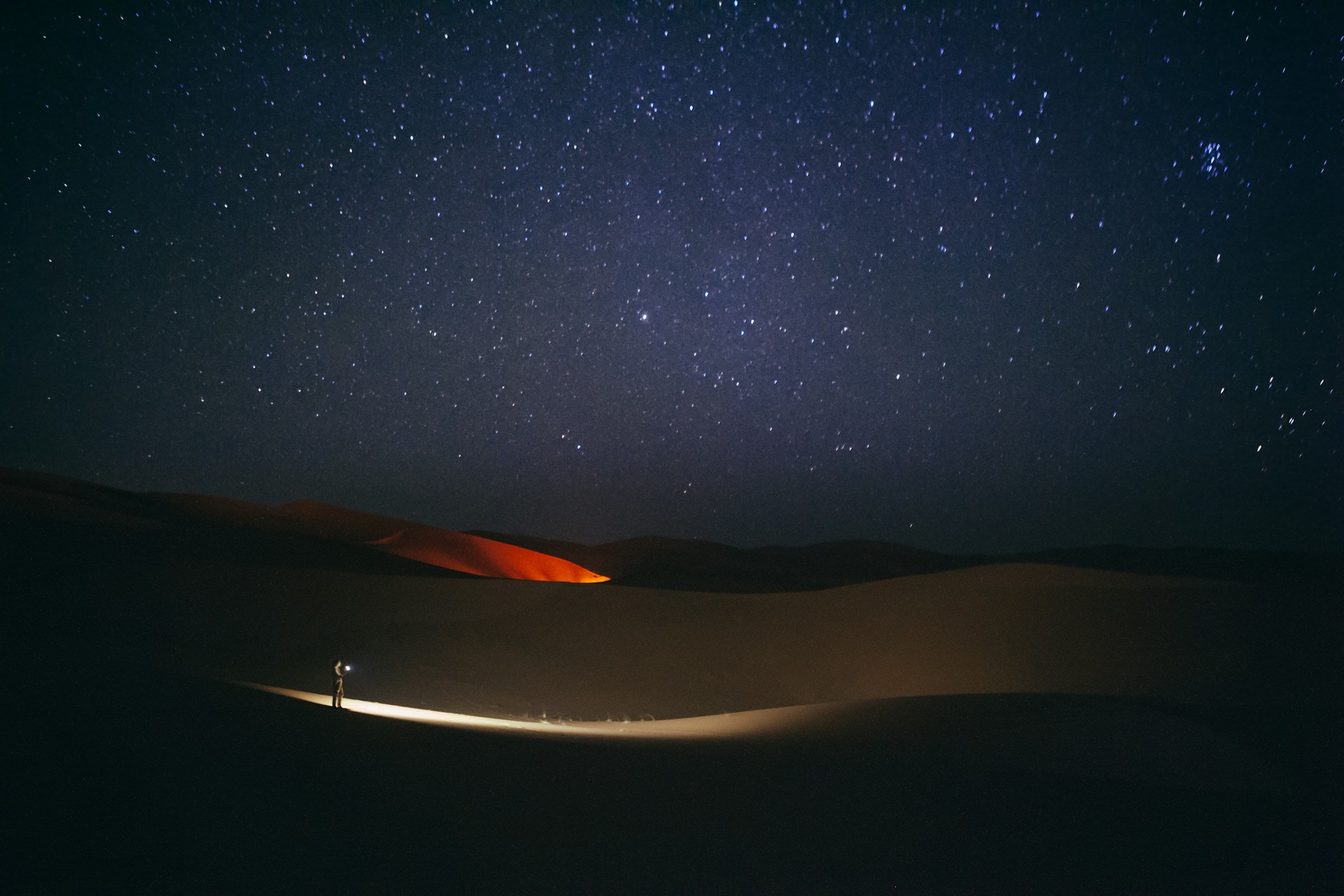
The big challenge in the UAE is light. City glow washes out all but the brightest meteors, so the further you are from street lights, malls and towers, the more you will see. Desert areas away from the city and the mountains of the east give the darkest skies. Wherever you go, keep to places where you are allowed to be at night, tell someone your plans, take water and a warm layer, because desert nights in November are cool.
For a guided night instead, Dubai Astronomy Group is running a paid session in the Al Qudra desert from 10pm on Tuesday 17 November to 2am on Wednesday 18 November, from Dh150. Watching on your own is free: the best window is between midnight and first light on Tuesday and Wednesday, with the peak at about 4am on Wednesday. Check the weather forecast on Tuesday evening, as cloud or dust would hide the show.